

“Giving new meaning to Quality: The Arth”
We believe , the only way to go forward, is to strive on Quality, Quality Product along with Quality Packaging & timely Delivery.
In quality front, we try to procure the best grades of every raw material available. All fresh batches are checked for Tensile, Elongation, Hardness and Bursting Pressure before putting into production. Randoms checks are done on the production floor to remove any human error or deviation from the standards. Strict measures are taken to control the prescribed wall thickness of the hose, no. of reinforcement yarn coverage per inch and the finish.
Once the Hoses are manufactured, they undergoes three screening processes, where they are thoroughly checked, before passing on to the packaging department.
We also have our own research laboratory & we are also linked with few big research laboratories, and automobile workshops, where the products are first tested under variety of simulated conditions as well as in real life in automobile workshops, before being introduced in the market.
Today, We manufacture over 1700 different hoses and all are readily available; we believe timely delivery is as important as the quality.
We are also focusing on product range, new products are been introduced every fortnight with an idea to cover complete automobile, and tractor range in India and to make a mark in the international circuit.
We also undertake Customized EPDM Hoses queries, where the compounding can be altered as per the customer specifications which include, specific gravity, temperature & pressure requirement, costing, and material thickness.
All hoses we manufacture matches SAE-J20R4 and AS:420:81:Mar:2014 Specifications.

Tensile Testing machine
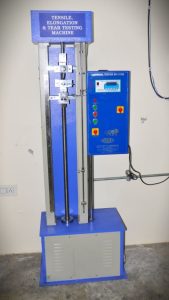
1. Testing at Raw Rubber (Compound Stage)
Before making hoses, we cut dumb-bell specimens from the rubber sheets and test them for:
✔ Tensile Strength (MPa)
Shows the strength of the rubber compound.
Higher = better pressure & burst resistance.
✔ Elongation at Break (%)
How much the rubber can stretch before it breaks.
Higher = better flexibility and vibration resistance.
✔ Modulus (M100/M300)
Measures stiffness.
Important for ensuring correct hardness & reinforcement balance.
Purpose for hoses:
✔ Ensures every batch of EPDM/NBR compound matches QC standards
✔ Predicts processing behaviour during extrusion & curing
✔ Rejects weak batches before production
2. Testing of Reinforcement Fabrics / Yarns
Our hoses use Polyester & Nylon reinforcement.
A tensile tester checks:
✔ Yarn/cord tensile strength
Ensures reinforcement layer can handle pressure.
✔ Fabric strip strength
Ensures braid/wrap layer bond is consistent.
Purpose:
✔ Ensures hose will resist internal pressure & pulsation loads
✔ Prevents burst failures during operation
3. Testing of Finished Hose Layers (Cut Sections)
From a finished hose, we test:
✔ Tensile strength of inner tube
Ensures oil/coolant-resistant layer is strong enough.
✔ Tensile strength of outer cover
Prevents cracking, splitting, or tear propagation.
✔ Adhesion between layers (after peel)
Often done on the same UTM with a peel fixture.
Purpose:
✔ Detects poor bonding or under-cure
✔ Ensures durability under heat (120–150°C)
✔ Improves life in engine bay vibrations
Rheometer
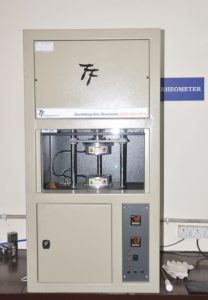
A rheometer ensures:
🔸 Consistent hose strength
Proper cross-linking = better burst strength, heat resistance & life.
🔸 Stable processing
Predicts:
-
Milling behavior
-
Extrusion smoothness
-
Vulcanization time
🔸 Quality control
Detects:
-
Poor filler dispersion
-
Wrong mixing temperature
-
Batch variation
-
Scorch issues
Aging Oven
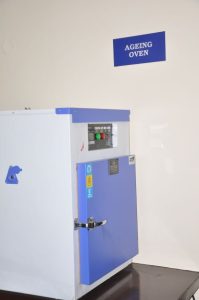
An Aging Oven (also called Hot Air Oven / Air Circulating Oven) is used to simulate the long-term high-temperature conditions that a hose will face inside a vehicle engine compartment.
It helps evaluate how the hose materials will behave after months or years of real usage.
This makes it one of the most important testing equipment in our laboratory.
1. Checks Long-Term Heat Resistance of Rubber
Hoses operate at 120–150°C (coolant/oil/under-hood temperatures).
The aging oven accelerates this by testing rubber at 70°C, 100°C, 125°C, 150°C etc.
It shows how rubber changes after heating.
The oven reveals:
✔ Hardening
✔ Cracking
✔ Loss of flexibility
✔ Surface degradation
✔ Change in tensile & elongation
2. Ensures Hose Durability & Life
Aging tests predict real-life performance of EPDM/NBR hoses.
After oven exposure, we test the samples again for:
-
Tensile strength
-
Elongation
-
Hardness
-
Compression set
Loss of properties = weak compound or poor curing.
Benefits:
✔ Ensures hoses will survive engine heat
✔ Reduces premature failures
✔ Prevents customer complaints & warranty issues
✔ Validates compound quality from suppliers
3. Helps in Compound Development & R&D
When developing new hose compounds, the aging oven helps compare:
-
Different EPDM grades
-
Different NBR blends
-
Different carbon blacks / fillers
-
Different cure systems
Aging results help us select:
✔ Best heat-resistant compound
✔ Best stabilizer/antioxidant package
✔ Optimum cure system for longevity
4. Verifies Cure Quality After Vulcanization
Under-cured rubber will degrade quickly during heat aging.
By placing samples in the oven (24–96 hours), we can check:
-
Whether cure is proper
-
Whether mixing temperatures are correct
-
Whether cure time needs change
Benefits:
✔ Detects under-cure or over-cure
✔ Improves production consistency
✔ Helps maintain batch-wise quality records
Specific Gravity Gauge

A Specific Gravity Gauge measures the density of rubber (ratio of weight to volume).
It is a simple but extremely important QC tool for rubber compound quality.
1. Ensures Correct Compound Formulation
Each rubber compound has a specific expected density range depending on:
-
Polymer type (EPDM, NBR)
-
Carbon black loading
-
Oil content
-
Fillers (CaCO₃, silica)
If density goes outside the target range, it means:
✔ Over/under filler addition
✔ Wrong oil percentage
✔ Wrong batch mix
✔ Material contamination
Benefit:
Prevents defective hoses due to wrong compound formulation.
2. Quick and Easy Incoming Raw Material Check
Before using new material lots, SG testing helps detect:
✔ Lower-quality polymer
✔ Change in carbon black grade
✔ Moisture–filled fillers
✔ Cheap filler adulteration
Benefit:
Avoids bad material entering production.
3. Detects Mixing Issues During Compounding
During mixing in Banbury or kneader:
-
Under-mixed or over-mixed compounds
-
Poor dispersion of carbon black
-
Oil not absorbed properly
-
Wrong ingredient addition
These issues immediately show up in SG test.
Benefit:
Gives fast feedback to correct mixing parameters.
4. Helps Maintain Batch-to-Batch Consistency
For hose manufacturing, consistency is essential for:
-
Tensile strength
-
Elongation
-
Burst pressure
-
Adhesion
-
Ozone resistance
Specific gravity checks ensure every batch remains uniform.
Benefit:
Improves product repeatability & reliability.
5. Strong Indicator of Filler Loading
Density directly correlates with:
-
Carbon black percentage
-
CaCO₃ or silica level
-
Oil plasticizer level
Sudden change = possible tampering or mixing mistake.
Benefit:
Prevents low-strength hoses due to excess filler or low reinforcement.
6. Quality Control Before Extrusion
Before rubber goes to extrusion line for hose production:
SG testing ensures:
-
Compound is within acceptable density
-
Wall thickness will remain uniform during extrusion
-
No underweight or overweight issues
-
Correct swelling/flow behaviour during extrusion
Benefit:
Ensures smooth extrusion & consistent hose dimensions.
Bursting Pressure Testing Pump
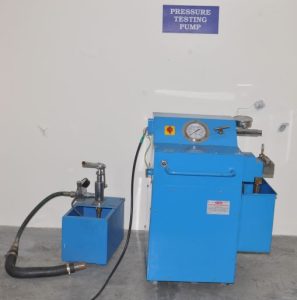
A Bursting Pressure Test Pump is a hydraulic test system used to check the maximum pressure a hose can withstand before it fails (bursts).
It is one of the most critical tests for automotive and industrial rubber hoses.
Burst testing can be:
-
Static burst test (slowly increasing pressure)
-
Proof pressure test
-
Impulse/fatigue pressure test (repeated cycling – higher-end equipment)
Why Burst Testing Is Essential for Hose Manufacturers
🔸 Ensures Hose Can Handle Real-World Pressure
Radiator, heater, and oil lines face high pressure and temperature cycling.
Burst pressure testing confirms:
✔ Hose will not crack
✔ Hose will not split under pressure
✔ Reinforcement is strong and properly bonded
✔ Hose is safe for the vehicle and customer
🔸 Validates Reinforcement Strength
Reinforcement (Polyester/Nylon) is the MAIN factor behind pressure resistance.
Burst testing checks:
✔ Quality of reinforcement yarn
✔ Correct wrapping/braiding pitch
✔ Proper layer bonding
✔ Correct wall thickness
If reinforcement is weak → hose bursts early.
🔸 Detects Manufacturing Defects
The pump helps identify issues such as:
-
Thin wall sections
-
Poor adhesion between layers
-
Improper cure
-
Air pockets/voids
-
Overloaded filler in rubber
-
Yarn slippage or improper wrapping
Benefit: Weak hoses are caught BEFORE dispatch.
Muffle Furnace
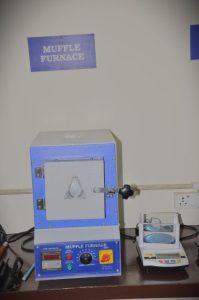
A Muffle Furnace is a high-temperature chamber (500–1200°C) used for ash content, filler analysis, and material verification of rubber compounds.
1. Determines Ash Content (Filler Loading)
Rubber compounds contain fillers like:
-
Carbon Black
-
Calcium Carbonate
-
Silica
-
Clay
-
Zinc Oxide
-
Process oils (burn off)
A muffle furnace burns off all organic rubber material, leaving behind pure inorganic ash.
Why this is important:
✔ Ensures correct filler percentage
✔ Detects if excessive CaCO₃ or cheap fillers were added
✔ Maintains strength, burst pressure & durability
✔ Confirms compound formulation accuracy
2. Helps Maintain Consistency of Rubber Compound
If compound density or tensile properties suddenly change, the muffle furnace helps identify why.
Changes in ash content indicate:
✔ Mixing error
✔ Wrong ingredient addition
✔ Supplier batch variation
✔ Poor dispersion
This ensures every batch meets standard performance.
3. Detects Rubber Adulteration or Material Mixing Issues
In some cases, suppliers may mix:
-
Lower-grade carbon black
-
Excess CaCO₃
-
Recycled rubber powder
-
Unplanned fillers
Muffle furnace testing easily detects this.
Benefit:
Prevents weak hoses and burst failures.
4. Essential for R&D and Compound Development
In new compound development, muffle furnace helps in:
✔ Optimizing filler loading
✔ Controlling cost without reducing strength
✔ Comparing carbon black grades
✔ Balancing hardness vs flexibility
✔ Improving heat & oil resistance
This directly improves our hose performance & cost efficiency.
5. Helps Investigate Field Failures
If a hose fails during customer use, ash analysis reveals:
✔ Was filler too high?
✔ Was the wrong compound used?
✔ Was there rubber contamination?
✔ Did heat aging alter composition?
This helps improve quality and prevent repeat failures.